
Goodbye typing, hello voice search: This is what it means for your SEO
In 2019, 20% of all mobile searches were conducted via voice search. For 2020, 50% of all searches worldwide are predicted to be conducted via voice search. We take this prediction with a grain of salt, but we do believe that voice search is going to become increasingly important. In this article, we look at how we can already take into account NOW when setting up our websites to help voice searchers find the right information.
It has been on the trend lists for years: the rise of voice search. In 2008, when Google introduced voice search in the Google Assistant app, it was still seen as a "funny thing". Meanwhile, the big boys have jumped on voice-activated interfaces: Amazon's Alexa, Apple with Siri & Homepod and Microsoft with its voice assistant Cortana are just a few examples.
From keywords to search phrases
One of the main changes we see is that searches are getting longer and longer. A search query typed into the search field will consist of 1 to 3 words at most. A spoken search quickly consists of many more words.
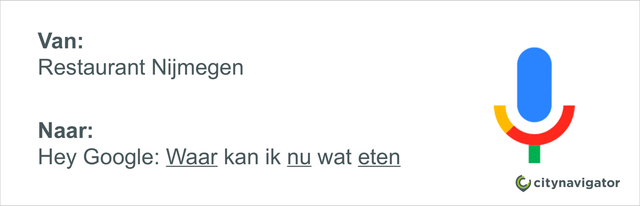
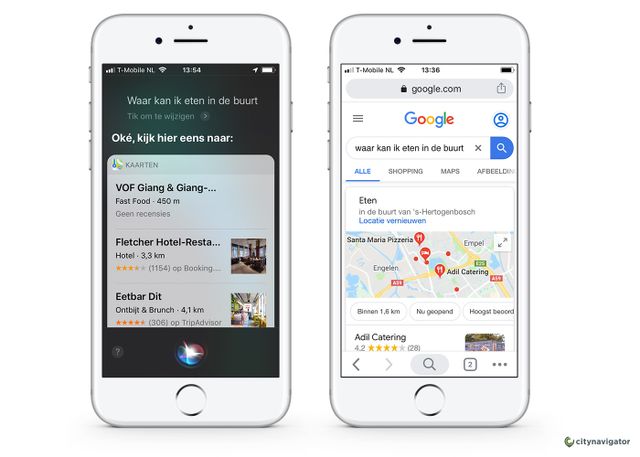
If you are looking for a restaurant on your mobile phone, you might type in something like "restaurant Nijmegen". If you perform a search by voice, you are more likely to actually formulate a question, such as "where can I eat in Nijmegen?".
Search phrases provide insight into the customer journey
The sentence spoken says a lot about the decision intention of the searcher.
Words like "who, what, where, when and how" are added to the voice search, because we actually expect to get an answer. Questioning gives us insight into what point in the customer journey a searcher is at.
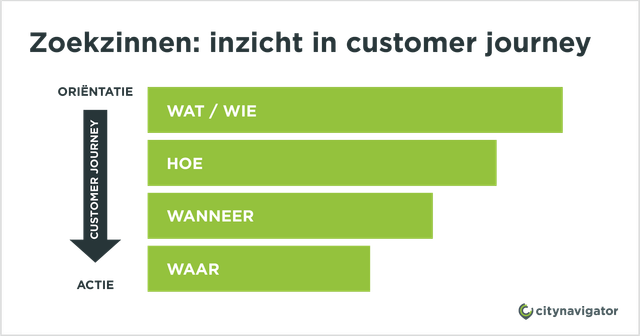
A question like "what can I do in Nijmegen?" tells us that the searcher is still in the orientation phase. When asked "when is restaurant Nibbles open?", we are almost certain that a table will be reserved.
SEO and Voice Search Optimisation: 5 tips
Tip 1: Create content that answers "the question
So start from the 5 W's (who, what, where, why, when...and HOW) and write your content accordingly. It is important that you answer the question (briefly!) first (that content can then be spoken, or appear in the search snippet).
Then explain your answer (in more detail). That way, Google knows very well which answer you gave to the original question and you support the "proof" of the answer with the rest of the content. All this "residual content" again ensures ranking and findability in the "traditional way".
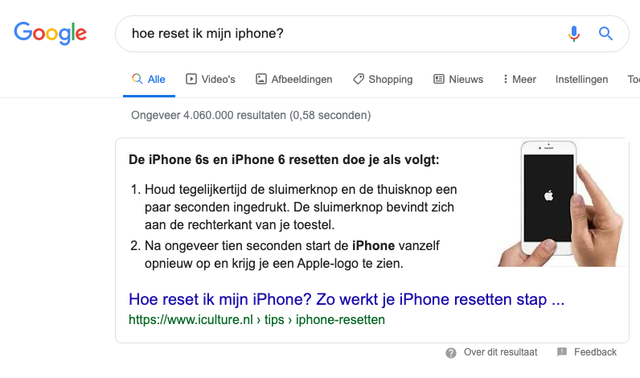
A great example is answering the question "how do I reset my iPhone?". Google instantly provides the answer:
Even a simple question like "when is restaurant Nibbles open?" can be answered directly by Google.
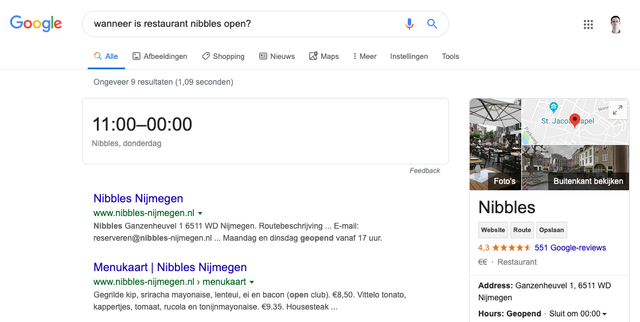
Google's E-A-T principle (Expertise, Authoritativeness, Trustworthiness) is one of the most important ranking factors. It helps determine whether YOUR answer is the most correct answer. The observant viewer sees that the "right answer" is made super important. So the number 1 position becomes even more important. If you consider that a smart speaker only gives one answer, you understand how important it is to have the "right answer to the question"!
Tip 2: Create demand-driven content
We already work with the "toptask methodology" ("give visitors what they ask for"), but we can go one step further. Put your ear to the ground at the hosts and hostesses in town, or at the visitor centre in town. You can also check your website's search logs in Google Analytics to collect frequently asked questions. Then write some blog articles answering the most common questions, or create a "frequently asked questions" page.
Tip 3: Speak your visitors' language: conversational keywords
People talk differently than they type. You as DMO talk a different language from your guests. A good example are the 4-day parties in Nijmegen. Just ask a random Nijmegen resident "do you go to the 4daagsefeesten?" and he will say "oh...you mean the summer festivals?" And did you know that the German guests talk about "Holland" instead of "Netherlands"? If you make use of the keywords your visitors use, you will also be found much better.
Tip 4: Make sure your pages are "localised
A voice search is 3x more likely to be a locally oriented query. It is a question, where you hope to find the answer nearby. When you perform a search on your mobile phone, your location is already used when returning search results. Therefore, always mention the place your page is about.
It is also important that you send important metadata to Google (e.g. address data, event data and opening hours). In plaece.base, we already send the most important metadata.
Tip 5: Keep doing what you've always done!
All the things you already do in terms of search engine optimisation remain super relevant to give search engines more context. A good URL structure, good use of keywords in title and texts, short web texts and specific landing pages. All these ingredients help visitors (and, of course, search engines) make your page easy to find.
Structured data: Speakable (BETA)
Metadata (or structured data) is sent to the search engines in the background. Schema.org (founded by Google, Microsoft, Yahoo and Yandex) has an overview of all structured data that gives the search engines more context about your pages. A new type of structured data is now also available: Speakable.
It makes it possible to send a piece of text to the search engines that can actually be spoken by a smart speaker. At the time of writing, the technology is still in beta and only available in the US and for English-language users. In addition, "speakable" is only supported for publishers of news stories. Once enough publishers have implemented "Speakable"-structured data, Google may roll it out to other countries and languages. To be continued!
The risk of voice search
Google's power is growing, with almost 60% of visitors already coming via Google.
"Once Google starts answering search phrases ever better in the traditional search engine, or via a smart speaker (or any device without a screen), someone will no longer need to visit the website itself."
You may be at the top of Google, or your answer may be pronounced, but the visitor no longer visits your website! Google gets higher and higher rankings (and thus sells more and more ads), but your website gets fewer visits. So the "race to get to 1 in Google" becomes a very dubious battle. If you don't rank 1, people don't click through. If you do rank 1, they won't click through either, because they already know the answer.
Additional challenge is that there is no one to verify whether the answer given is correct... The number of examples of "fake news" is legion, this will only become a bigger problem. Information on Wikipedia we already have to take with a grain of salt, but surely Google will tell the truth? All in all, then, very interesting developments, but developments we should keep a critical eye on!