
Enrich your website with external data sources and connectors
Providing a rich visitor experience on your website is a top priority. Experience, inspiration and information go hand in hand, but how do you get the right information? And how do you maintain that enormous amount of data? By using a "connector", you can easily connect to an external data source and greatly increase the offer on your website, without having to bear the editorial burden yourself.
These connectors are already available:
Click here for the overview mhe connectors
Connectors and external data sources
A connector is a technical link between two data sources. This link ensures that information from both systems can be exchanged. This is often done at least once a day, to ensure that all information is and remains up-to-date. We make a kind of "copy" of the external data in our own Base Platform, so to speak. We do this to be able to combine multiple data sources and not to be dependent on the availability of the external party (there is nothing more annoying than having the external data source's website offline).
An external data source could be, for example, real-time availability information for accommodation. We can read these data sources directly from the source and integrate them into the website.
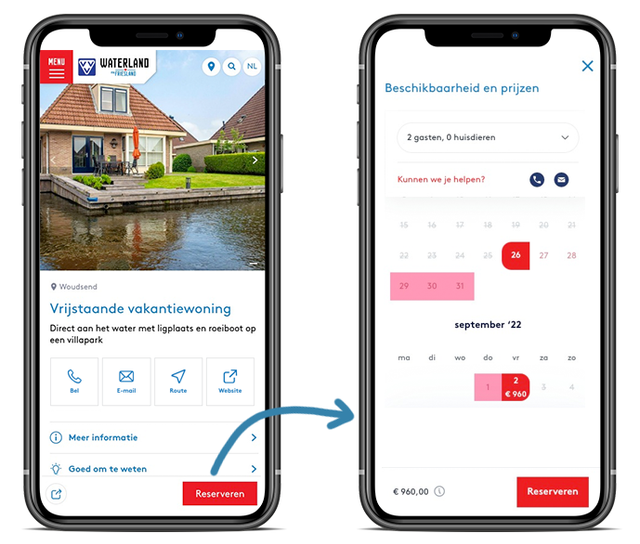
Example of real-time availability information on www.friesland.nl
External data sources
There are many other parties where it is interesting to establish a link. Think about cinemas, theatre stages or other tourist organisations that manage their own content. These parties often own a (small) range of events, which can enrich the website's events calendar. In this way, you offer the widest possible range of content on your own visitor website. You bundle the fragmented supply in one location. That's nice for the visitor!
A connector: this is what you need
To realise a connector, it is required that an external party has access to a "feed". A "feed" is a readable data format (readable by computers, usually not by humans).
This is an overview of all data that can be exchanged. For each party, the feed may look different and contain different information, which is why it is always necessary to create a specific link for each party. A minimum set of data should be available to link the feed (think of a name and date).
An external party may also operate nationwide. An example here is Pathé (the cinema, not the meats ;-)). Pathé has a national offer of films, but can offer them per city. Because we have already realised a Pathé connector for one of our partners, it can very easily be used for another destination.
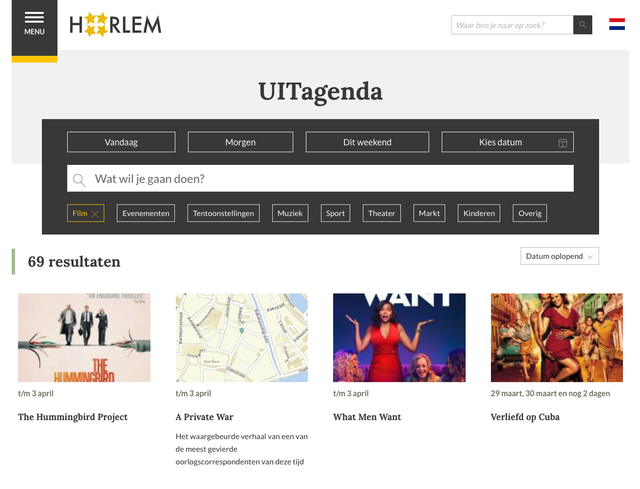
Example of Pathe films on Haarlem.nl
These are the advantages of external sources and connectors:
- There is an automatic flow of new information stored in the Plaece.base.
- Editors are spared the editorial burden of creating this new content.
- Editors can customise, approve and publish the event.
- All information is converted to a universal format and can therefore be more easily exchanged with other tourism organisations.
- All data is fully integrated on the same website domain. You do not lose authority in Google.