
Improved indexing and findability with Base sitemaps
Most visitors come to your website via a search engine. By search engine, we actually mean Google. How well you are found obviously depends on a lot of factors. These factors are also known as SEO: Search Engine Optimisation. Fortunately, you yourself have a lot of influence on how to make your pages findable. One of the elements we have recently optimised is the provision of sitemaps. All location, event, route and arrangement pages are now offered to Google through a sitemap.
Crawling and indexing
Google crawls the internet (and also your website). You can think of this process as a robot (spider) clicking on all the links it finds on the internet. Every page it finds is stored in an index. An index is a kind of table of contents of the entire internet. Now Google has an overview of all the pages that exist. In this way, Google itself automatically discovers all the pages that exist on the entire internet (this is obviously a very simplistic explanation of crawling and indexing, but good enough for now 😉 ).
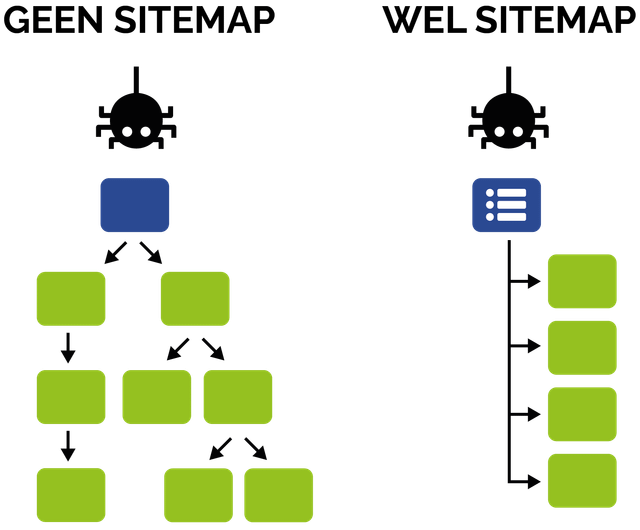
You can help Google crawl and build the index. You do this by supplying a sitemap of your website. This sitemap contains all the pages of your website. This way, Google does not have to scan your entire website itself and follow all the links. This also allows you to provide pages that Google would otherwise not have found (or would have had difficulty finding). So you are a lot more complete.
Indexing of locations, events, itineraries and packages
We have been offering a sitemap for content pages on the website for some time, but not yet for detail pages from the plaece.base. These were indexed purely because they could be crawled by the crawler via links. This has been changed. Now sitemaps are also automatically generated for all locations, all events, all routes and all packages.
This is how the sitemap.xml works
A sitemap.xml is nothing more than a table of contents of all the pages of your website. We create sitemaps per "content type" and per language. So you get a special sitemap for all locations, one for events, etc.
But how does Google know about the existence of these sitemaps? We tell Google in a robots.txt file.
A robots.txt is a file located in a fixed place on every website so that Google can find it(even Google has a robots.txt). It contains an overview of all sitemaps available for your website (e.g. https://www. waterlandvanfriesland.nl/robots.txt). Take a look at your own robots.txt:
https://www.jouwwebsite.nl/robots.txt
You will then see something similar:
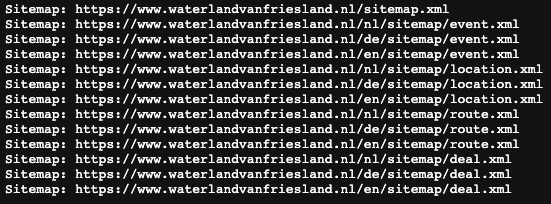
You see the url of your website and an xml file per language and 'content type'. This xml file is an overview of all urls that Google is allowed to crawl.
The event.xml in Dutch contains a table of contents of all event pages. There are probably hundreds of events you want to submit to Google, but only a maximum number of links are allowed in one sitemap. This is why the event.xml file contains a list of all pages that contain individual events.
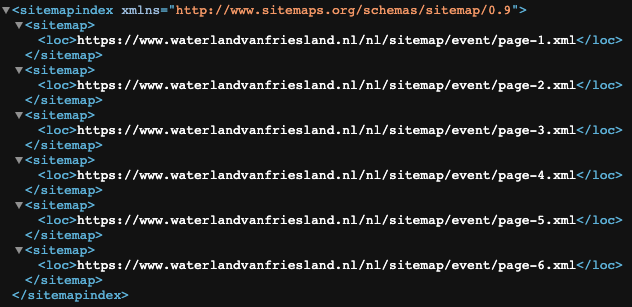
If you then go another layer deeper (e.g. to https://www.waterlandvanfriesland.nl/nl/sitemap/event/page-1.xml), you get links to all individual events on your website.
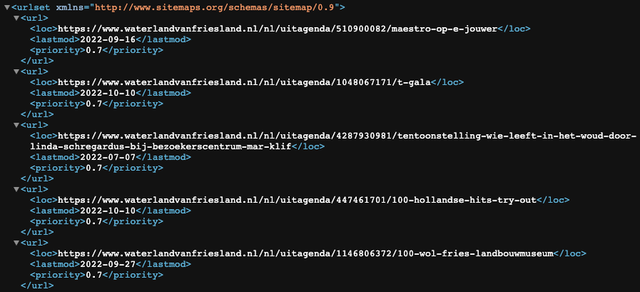
These events are automatically submitted to Google. As soon as you change an event in Base, the date of the change will also be changed in the sitemap. Once Google revisits the sitemap, it will only crawl and index the changes since the last time.
The result of Base sitemaps
Since the implementation of the Base sitemaps, the location, event, route and arrangement pages are better indexed in Google. Significantly more pages are included in Google's index.
You are no longer dependent on the Google crawler that has to follow all the links on your website, but you deliver all the urls of your website to Google to be indexed.
Base sitemaps are immediately available to you
We have automatically added the sitemaps for you, so we automatically tell Google everything about all your locations, events, itineraries and deals. These new features are available from version 2.48 of the plaece.creator. So all you have to worry about is good content, and filling it with the right SEO information.
Any questions? Feel free to ask them via support@insiders.nl