
Plaece.base moved to Google Cloud Platform
After more than a year of preparations, the new hosting platform was officially launched last week. During all the preparations, all applications were prepared to move servers and to be ready for the new way we build and host web applications. We are doing this because we are running more and more applications (now over 100 tourism websites), have more data to process and are also welcoming more and more visitors to all our sites. With this monster migration, we have more capacity, more stability and we are ready for the future!
On Wednesday 19 February, the migration of plaece.base to the new hosting platform was successfully completed. Through this blog post, we would like to tell you more about why this migration took place and what the benefits are.
In short, the new hosting platform has the following advantages:
- Stability and reliability with Kubernetes and Google Cloud Platform
- Traffic isolation per website
- Fully automated and scalable
- Improved server statistics and logging
- Automated quality checks and deployment process
- Physical relocation from Ireland to Groningen
We are extremely proud of the fact that we have been able to implement these changes for all our partners. We realise that the story below has become quite technical, but we really do want to tell it 😉 . So in case you are already reeling from terms like: Kubernetes, containers and redundancy, no problem. No hard feelings. Will you read on? TOP! We have tried to tell everything somewhat in Jip and Janneke language.
Stability and reliability with Kubernetes and Google Cloud Platform
By using Kubernetes (originally invented by Google) on the Google Cloud Platform, the overall quality and further development is also guaranteed.
Kubernetes is Greek for ‘ship’s helmsman’
Kubernetes works with 'pods'. A pod is a shell for one or more containers. The app (in our case, the plaece.base) is packed in a box (container), so to speak, containing only what is most necessary to function. Kubernetes works with Docker containers, which are by far the most popular.

Photo by chuttersnap
By working with containers, you can quickly create isolated applications and then have them work together again. But that independence and scalability also brings challenges. You soon have dozens of containers running that you have to monitor and manage. Therein lies the power of Kubernetes. With Kubernetes, you can manage, monitor and make all these containers and packages work together. Kubernetes has become the most popular standard for deployment and management (orchestration) of containers in a very short period of time, and for good reason.
Traffic isolation per website
Previously, multiple websites could run on 1 server. This could mean that if website A was very busy, website B could suffer. With the new hosting set-up, each website has its own reserved capacity.
We isolate all websites so that they no longer ‘interfere’ with one another
In this way, we ensure that it will never again happen that other sites are delayed due to heavy traffic.
Fully automated and scalable
Besides the isolation of all websites, the servers of the individual websites are also automatically scalable.
As soon as traffic increases, an additional server is added (fully automatically)
Capacity is automatically increased when it gets busy. This happens in a fraction of a second. So a visitor will not notice anything. This also means that the website does not run on 1 server, but can run on up to 10 different servers at the same time to cope with the capacity. Again: As a visitor, you won't notice this at all (except that the site is normally accessible and usable 😀).
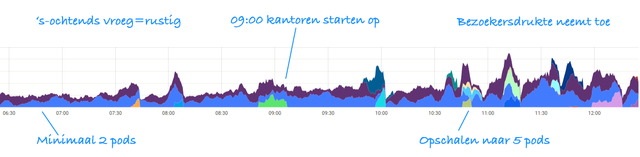
There is less risk of downtime, because each website runs redundantly. If a server fails unexpectedly, other servers are always available or a new server is switched on immediately. The data centre and network connection are also redundant; the hosting platform is spread across three data centres.
There is always a minimum of 2 servers on which the website runs. If one server crashes, a new one will automatically start up (self-healing).
Improved server statistics and logging
Thanks to the extensive tooling of Kubernetes and Google Cloud Platform, we now have more and better statistics and monitoring. We can check the status of an individual website/server/pod at any time. We also have extensive notifications, should things go wrong. At that moment, we can take immediate action to prevent problems.
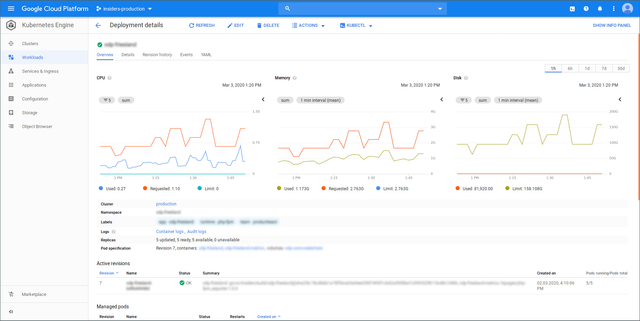 Example of monitoring in Google Cloud Platform
Automated quality checks and deployment process
By using automated processes, the risk of errors is minimised. Because all code is tested automatically, the chance of "non-working" code ending up on a live website is significantly reduced.
It is also possible to use your own programming language for each application. This allows you to choose the most efficient programming language for the task at hand. This way, your entire application will become a lot more efficient and faster.
Physical relocation from Ireland to Groningen
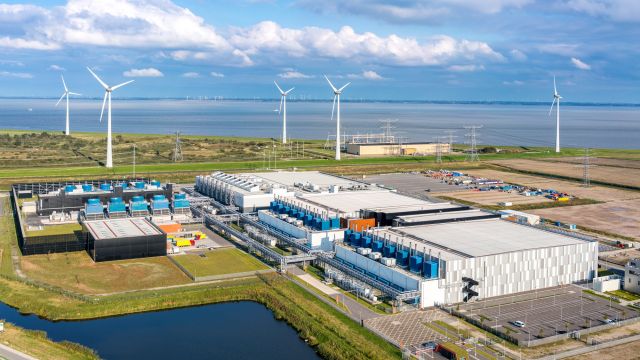 Previously, we used Amazon Web Services. These servers ran in Ireland. Since we are a Dutch company and work for the most beautiful destinations in the Netherlands, it was only logical that our web servers and data were also located in the Netherlands.
An additional advantage is that Google's data centre is set up very sustainably. For example, the data centre runs 100 per cent on sustainable electricity from wind turbines and solar panels (and uses 3.5 times less power than other comparable data centres). To find out more, check out Google's video on the Dutch Google Cloud Platform
The servers of our new hosting platform (Google Cloud Platform) are located in the data centre in the Eemshaven in Groningen. With the relocation of the plaece.base, our Elasticsearch servers were also moved, so that our search engine can also search more efficiently.
What's next?
In the coming period, we will continue to optimise all processes and servers so that we can enjoy our new hosting environment to the full. The next step we will now take is also moving all websites to the new hosting platform. Right now, we are busy making all preparations to ensure that this transition, too, will be smooth and without downtime.