The best domain name and SEO strategy for international visitors
Do you have a website with multiple languages and do you target visitors from different countries? Or do you focus on foreign tourists when they are in the Netherlands? The purpose of your website influences the choice for a suitable domain extension. Do you opt for a .nl or a .com domain? What settings do you use within Google Search Console for international targeting? Read about our test case here.
There are several ways to tell Google in which languages your website is available and which visitors you target in which countries. When you choose a .nl domain, you inform Google that you have a website with a focus on users in the Netherlands (in most likely the Dutch language). With a .com website, it is possible to indicate within Google Search Console which country you focus on with your website.
When should you use a .nl domain name?
Do you have a website with a focus group of users in the Netherlands? Then a .nl website is the right choice. Here, the website is automatically targeted at the Netherlands. This means that the website is given priority in rankings within Dutch search results. Even if your website is available in different languages, focusing on foreign tourists who consult the website during their stay in the Netherlands, a .nl is an excellent choice. By means of subdirectories (for example: https: //www.friesland.nl/de) and hreflang tags, you ensure that visitors arrive at the correct language version of the website.
What are hreflang tags?
If you have multiple versions of a page for different languages or regions, inform Google of these variants. If you do this, you help direct users to the most appropriate version of your page per language or region. Read more about hreflang tags.
An example of a hreflang tag for a German website:
Benefit:
- Priority in Dutch search results
- By using the .nl domain name, you indicate that your website is for Dutch users (people in the Netherlands, which language they speak is in principle independent of the domain extension).
Disadvantages:
- A foreign visitor visiting the Netherlands (e.g. a German) who uses his mobile phone to search for something on Google will most likely use German Google(https://www.google.de). A .nl domain name is not specifically targeted at Germany, so it will not be given priority in German search results.
When should you use a .com domain name?
Is your website available in several languages and do you not have one country as your focus audience? Then it is advisable to opt for a .com website. For example: If you have an English-language website and want to reach foreign visitors where English is spoken. This does not target geographically, but by language. The advantage is that with a .com website, you still have the possibility to set geographical targeting within Search Console. Suppose your website has different languages on a subdirectory, .com/en, .com/en, .com/it. Then you can indicate separately for the Italian variant that you focus on residents of Italy (for a .nl domain extension, geotargeting on a subdirectory is not possible!).
.com and .eu domain extensions are ‘language-agnostic’ and ‘location-agnostic’, so they can be geo-targeted via subdirectories.
Benefits:
- All SEO value collected on one domain
- More visitors to your website ensures higher authority
- Option for international targeting within Google Search Console
- You can set Spanish/French, etc. to "unlisted", because many countries speak that language.
Disadvantages:
- A .com domain looks less attractive than a .de or .fr domain extension. But SEO-wise, it would be smarter.
How does it work with a .de/.fr domain name?
A .de or .fr domain name is geotargeted to the corresponding countries (Germany and France). Visitors who speak German in Austria/Switzerland are not specifically targeted. French-speaking visitors in the French-speaking colonies are also not specifically targeted. So think carefully about which countries you want to target (and realise that a domain name cannot be linked 1:1 to a language).
For Google, a domain extension has nothing to do with language, but with the associated country. When should you opt for a subdirectory?
When do you choose subdirectories with languages or a domain name per language?
Basically, from a SEO perspective, it is always smarter to choose a .com domain extension, because then you can geotarget subdirectories specifically by country. Ultimately, you create subdirectories per country and not per language.
How does international targeting work within Google Search Console?
Within Google Search Console, it is possible to indicate which country you focus on with your website. This is only possible with a .com website (again: for a .nl domain extension, geotargeting by subdirectory is not possible!). This way, you give priority within the search results in that country. If you have a .com/it website, you indicate that the website has priority within Italian search results.
There is also the option of selecting "unlisted" as international targeting. This indicates that the website is multilingual, but does not focus on one specific country. For example, English is spoken in several countries and you don't want to prioritise only English or only American visitors. You focus on all English-speaking countries. Then you choose "unlisted" within international targeting.
Please note: if you have a .com website and add it to Google Search Console, the website will automatically be targeted on America.
Test case: unlisted geotargeting on a .com domain
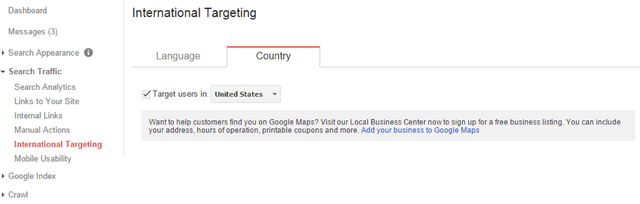
To see whether these settings really affect online findability and rankings within search results, we tested this. For visitnijmegen.com, we set the international targeting to "unlisted" in Google Search Console. This signals that the website is multilingual, but does not target a specific country. Earlier, the website was automatically targeted on America because it is a .com website.
Three months on, what do we see in the results?
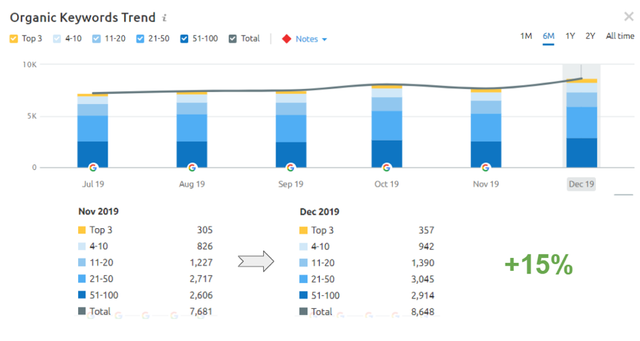
Within Dutch search results, we see a 15% increase in the number of top 10 keywords within a month (November-December). This is because we no longer specifically state that the website is for American visitors.
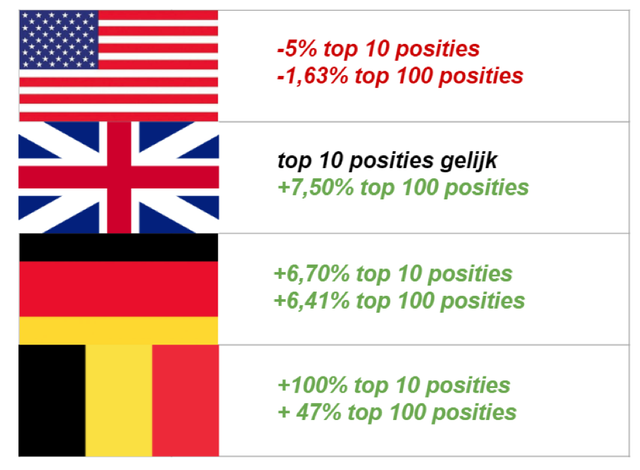
Logically, we see a decline in rankings within US search results. While the other countries show a significant increase. In particular, rankings within Belgian search results have risen significantly.
Conclusion:
Websites with a .com domain extension set to "unlisted" in Google Search Console are easier to find in Google search results in other countries.